
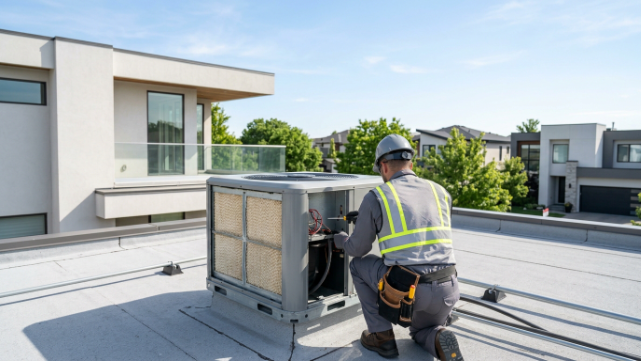
On a dry Melbourne summer afternoon, an evaporative cooler working properly makes a genuine difference to how liveable a home feels. When it stops performing — blowing warm air, leaking water, or refusing to start — the discomfort is immediate. Understanding the most common causes of failure and what evaporative cooling repair involves helps homeowners make faster decisions and get the system back up and running with less frustration.
How Evaporative Coolers Work and Why That Matters for Repairs
Unlike refrigerative systems that compress and cycle refrigerant, evaporative coolers work by drawing warm outside air through water-saturated pads. As the air passes through the wet pads, the evaporation process drops the air temperature before the fan distributes it through the home. The simplicity of this mechanism is part of what makes evaporative systems cost-effective to run — but it also means the pads, pump, water distribution system, and fan are all critical to performance and all subject to wear.
Most evaporative cooling faults trace back to one of these components, and identifying which one is the starting point for any repair.
Signs the System Needs Attention
Some issues are obvious and others are subtle until the system stops working entirely. Common indicators that an evaporative cooler needs professional attention include:
- Warm or barely cooled air coming through the vents despite the system running
- Water leaking from the unit onto the roof or into the ceiling space
- The pump running but no water reaching the pads
- The fan operating normally but the cooling pads visibly dry during operation
- Unusual noise from the fan motor or a grinding sensation during startup
- The unit failing to start despite power being present at the isolator
- Musty or stale smells in the distributed airflow indicating pad contamination
What Repair Work Typically Covers
Evaporative cooling repair varies considerably in scope depending on the nature of the fault. Pad replacement is one of the most routine tasks — cooling pads deteriorate over time as mineral deposits from the water supply accumulate and reduce their effectiveness. A pump that has seized or lost prime is another common repair that restores water flow to the pads and brings cooling performance back quickly.
Float valve faults cause the unit to either overflow continuously or fail to maintain the water level in the base tray — both of which affect performance and can cause water damage if left unaddressed. Fan belt wear or motor issues on older belt-driven units produce noise and reduced airflow that progressively worsen without intervention.
More involved repairs include water distribution manifold replacement, motor overhaul or replacement, and addressing corrosion in the unit’s tray or housing that develops over years of water exposure in areas with hard water supply.
Repair vs Replacement: Knowing the Difference
For units more than ten to fifteen years old showing multiple faults simultaneously, the question of whether repair remains the right approach is worth raising with the attending technician. A system that has had repeated repairs across successive seasons may be approaching the point where replacement delivers better long-term value than continuing to address individual components as they fail.
A good technician will give an honest assessment of the unit’s overall condition rather than recommending expensive repairs on a system that is unlikely to deliver reliable service for much longer regardless of the work done.
Staying Ahead of Next Summer
The best time to identify whether an evaporative cooler needs repair is not when summer has already arrived and the unit is needed immediately. A pre-season inspection and service in spring — checking the pads, pump, float valve, motor, and water distribution system before they are put under load — gives the opportunity to address developing faults before they become urgent. For homeowners who rely on evaporative cooling repair to get through a reactive breakdown each year, shifting to a proactive service approach is what finally breaks that cycle.